How to Visit a Buddhist Temple in Thailand — A Complete Etiquette Guide
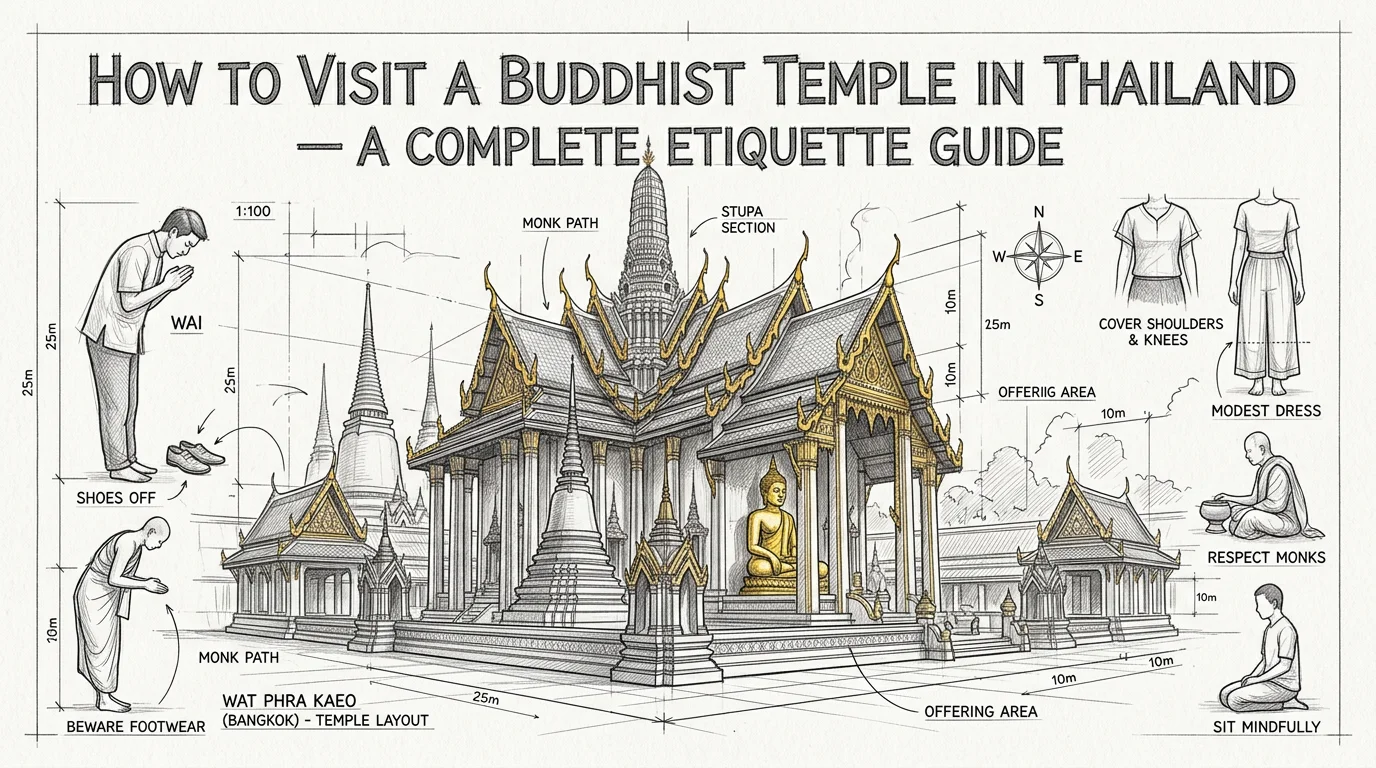
Thailand has more than 40,000 Buddhist temples — and almost all of them are open to visitors. There are no tickets, no reservations, no guided tours required. You simply arrive, remove your shoes, and step inside a space that has been sacred for centuries.
That openness is a remarkable thing. It is also a responsibility.
This guide is not a list of rules designed to intimidate. It is an attempt to explain the logic behind the etiquette — so that your visit feels natural rather than anxious, and so that the monks, worshippers, and community who call the temple home feel genuinely respected.
Dress Code — What to Wear
Thai temples are active places of worship, not museums. Dressing modestly is the single most important thing a visitor can do, and it applies to everyone regardless of nationality, age, or background.
The basics:
Shoulders should be covered — no sleeveless tops or spaghetti straps
Knees should be covered — no shorts, short skirts, or minidresses
Clothing should be clean and reasonably neat — beachwear and sportswear are not appropriate inside temple buildings
Loose, lightweight trousers and a shirt with sleeves are ideal for Thailand's climate and work perfectly at any temple. Many popular temples keep wraps or sarongs at the entrance for visitors who arrive underprepared — a thoughtful gesture, worth accepting graciously rather than avoiding.
For women, there is no requirement to cover the head inside most Thai Buddhist temples, unlike in some other religious traditions. The focus is on the body below the neck.
The underlying principle is simple: you are entering a place that holds deep meaning for the people who worship there. Dressing modestly is a way of acknowledging that meaning, even if you do not share the faith.
Shoes — When and Where to Remove Them
You will remove your shoes before entering any temple building — the ubosot (ordination hall), the viharn (assembly hall), and usually any enclosed shrine or chapel. Look for shoes left at the entrance; that is your cue.
Shoes are not required to be removed outdoors in temple courtyards, though some particularly sacred open-air areas may have their own signs or customs. When in doubt, follow what others around you are doing.
Leave your shoes neatly to one side of the entrance — not blocking the doorway, not thrown carelessly. This small act of tidiness is part of the same respect you bring through your clothing and your behaviour inside.
Behaviour Inside — Stillness, Posture and the Buddha Image
Inside a temple building, a calm and quiet presence is appropriate. Loud conversation, laughter, and phone calls are out of place. This is true even if the hall appears empty — it is rarely truly empty.
A few specific points:
Sitting posture matters. When sitting on the floor inside a temple, tuck your feet behind you or to one side — never point them toward a Buddha image or toward a monk. In Thai culture, the feet are considered the lowest and least sacred part of the body. Pointing them at something revered is genuinely offensive, not merely a technicality.
Never touch a Buddha image without explicit permission, and never climb on or pose irreverently with one. Buddha images — of any size, in any state of repair — are objects of active veneration, not decorative props.
Walk around sacred structures clockwise. Chedis (stupas) and certain shrines are traditionally circumambulated clockwise. It is not a strict rule enforced anywhere, but it is a meaningful gesture that locals will notice and appreciate.
Keep your voice low. Even a whispered conversation is preferable to a normal speaking voice inside an ordination hall or shrine room.
Photography — Thoughtful, Not Prohibited
Photography is permitted in most Thai temples, and many are extraordinarily beautiful — worth documenting carefully and well. However, a few principles apply.
Inside temple buildings, photography is often allowed but sometimes restricted. Look for signs, and if you are unsure, observe whether other visitors are photographing freely or not. Some temples post no-photography notices at the entrance to the most sacred halls.
Never photograph monks without their permission. This applies especially to monks in prayer or meditation. A monk who is sitting quietly, chanting, or performing a ritual is engaged in something private and meaningful — not posing for a travel photograph.
Be present first, photographer second. The best documentation of a temple comes from someone who has taken a moment to understand what they are looking at. Slow down. Look at the murals, the details, the light. Then photograph.
Do not use flash near fragile murals or in darkened shrine rooms. Beyond the cultural consideration, flash photography accelerates the deterioration of ancient painted surfaces.
Monks — A Few Special Considerations
Buddhist monks in Thailand occupy a position of significant religious and social respect. Interacting with them — if it happens naturally — can be one of the most memorable parts of a temple visit. A few things to bear in mind:
For women: Do not touch a monk, and do not hand anything directly to a monk. If you need to give something to a monk, place it on a table or on the ground nearby, or hand it to a man who can pass it on. This is not a slight — it is a requirement of monastic discipline that monks themselves are bound by.
For everyone: If a monk initiates a conversation, respond calmly and respectfully. Many monks — especially younger ones studying English — genuinely enjoy brief exchanges with foreign visitors. Do not rush the conversation or treat it as a curiosity.
When sitting near monks, do not position yourself higher than them if you can help it. In a context where seating levels are mixed, this is not always possible — but the intention matters.
Offerings and Participation — If You Feel Moved To
Many temples offer incense sticks, candles, and lotus flowers for sale near the entrance — small, inexpensive offerings that visitors are welcome to make. There is no obligation to participate, but if you would like to, here is the basic form:
Light incense or a candle, hold it between your palms in a wai gesture (hands pressed together, fingers pointing upward), and place it in the designated holder near the altar. There is no required prayer or intention — a moment of quiet respect is entirely sufficient.
Gold leaf squares are sometimes available for pressing onto Buddha images at certain temples. If this is offered and you choose to participate, follow what others do and be gentle.
You do not need to be Buddhist to make an offering. The gesture is one of respect, and it is always received as such.
The Spirit Behind the Rules
Temple etiquette in Thailand is sometimes presented as a minefield — a long list of things not to do, ways to offend without meaning to, mistakes that mark you as an outsider. That framing does a disservice to both the visitor and the tradition.
Thai Buddhist temples are, at their core, welcoming places. Monks and worshippers are accustomed to curious visitors. A foreigner who arrives with genuine interest, dresses appropriately, and moves through the space with quiet attentiveness will be welcome almost everywhere — regardless of whether they get every detail exactly right.
The rules of etiquette are not tests to pass. They are expressions of a particular way of understanding what is sacred, what is respectful, and what it means to share a space with something larger than yourself.
Come with that understanding, and you will rarely go wrong.
Thai Temple Archive documents Buddhist temples across Thailand through photography and field research. All temples in our database are open to respectful visitors.