What Happens Inside a Thai Temple That No Guidebook Explains
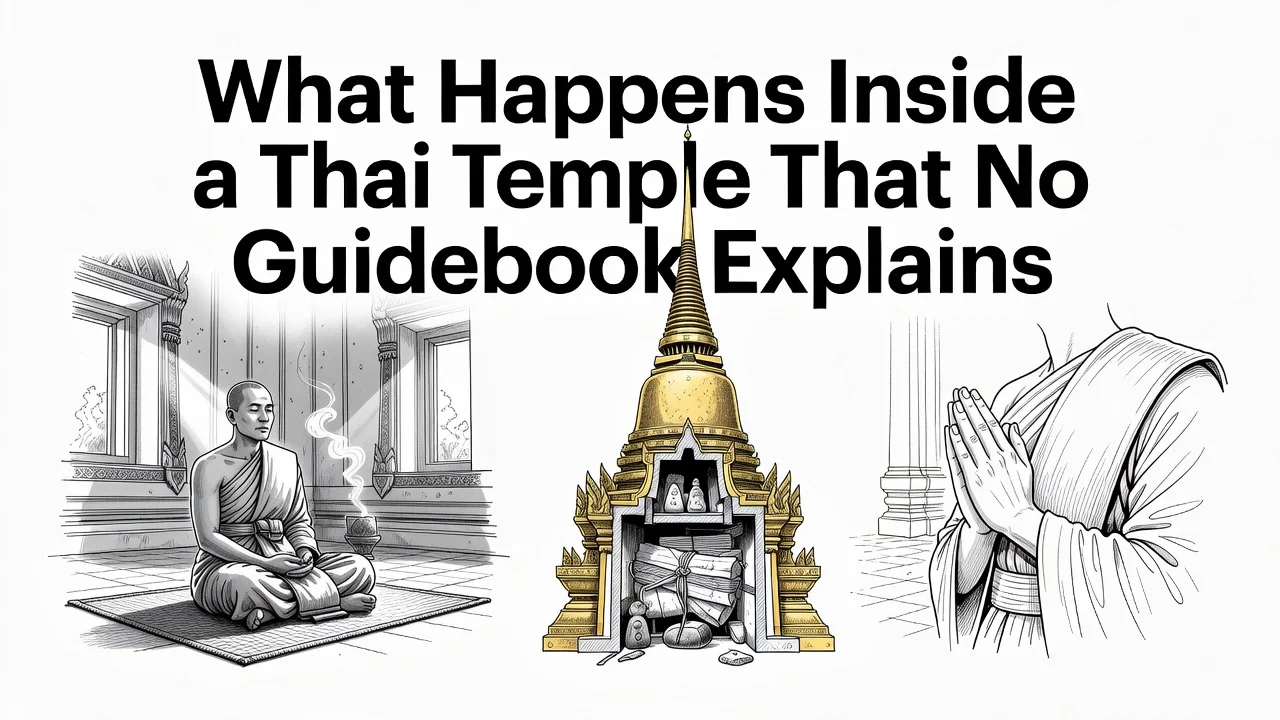
Most guidebooks tell you the same five things about visiting a Thai temple. Cover your shoulders. Take off your shoes. Don't point your feet at the Buddha. Don't touch a monk if you're a woman. Be quiet near the main hall. All true, all useful, and all entirely about how to behave as a visitor passing through.
None of it explains what a temple actually is when nobody is visiting at all — which is most of the time, for most of Thailand's 40,000-plus wats. A temple is not a museum that happens to have rules. It is a small, functioning institution with its own daily rhythm, its own internal structure, and its own relationship to the community around it that has very little to do with tourism.
The Day Starts Before Anyone Else Is Awake
By the time most visitors arrive at a temple — late morning, after breakfast, after the heat has already started building — the day's most important ritual is long over. Monks wake around four or five in the morning, well before sunrise, for an hour of meditation followed by chanting. Then, just after dawn, they walk out into the surrounding streets, barefoot, carrying alms bowls, in a practice called pindabat.
This is not a performance for visitors, though it can look striking to anyone who happens to see it. It is the literal mechanism by which monks eat — they do not cook for themselves, and many monastic rules forbid them from storing or handling money to buy food directly. Local residents wait for them with rice, curries, fruit, sometimes just enough for a single meal, and the act of giving is itself the point. The Thai concept of tam bun, merit-making, runs through this exchange: the giver gains as much from the moment as the monk does.
By the time a temple opens its gates to casual visitors, this entire cycle — waking, meditation, the alms round, breakfast — has already finished. What tourists see during the day is the temple at rest, not the temple at work.
A Temple Has a Hierarchy, and It Matters
Walk into any wat and it is easy to assume all the orange-robed figures inside hold roughly equivalent status. They do not. Thai monastic life runs on a structured seniority system based on ordination date and rank rather than age, education, or charisma — a monk ordained five years ago outranks one ordained two years ago regardless of either man's age.
At the top of any individual temple sits the abbot, responsible for everything from the temple's finances and physical upkeep to settling disputes among the resident monks and representing the temple to the wider community. Below him sits a structure of more senior and junior monks, novices (often teenage boys testing whether monastic life suits them before full ordination), and sometimes dek wat — temple children, frequently from poor families, who live on temple grounds in exchange for help with daily chores and a path to education they might not otherwise have.
This hierarchy extends nationally too. Thailand's Sangha — the entire monastic order — is organised into ranks culminating in the Supreme Patriarch, appointed by the king, with a governing council below him that oversees doctrine and discipline across the country. A small village wat with three monks is, formally, just as much a part of this national structure as the grandest royal temple in Bangkok.
The Temple as Village Infrastructure
Outside the major cities, a Thai temple is rarely just a religious building. For centuries it has functioned as the de facto community centre of rural Thai life — a role that predates, and in many places still outlasts, formal government infrastructure.
Before Thailand had a national school system, temples were where children learned to read, taught by monks who were often the only literate people in a village. Many still run schools today. Temples have historically served as the venue for the only large open spaces in small villages — used for festivals, community meetings, and in some places still functioning as a kind of town hall when the community needs to gather collectively. Temples also frequently absorb people that the rest of the social structure has nowhere else to put — the elderly with no family nearby, children whose parents cannot support them, people recovering from addiction or hardship.
None of this shows up in a guidebook because none of it is visible to a visitor walking through for twenty minutes. It only becomes apparent if you spend time in a temple's surrounding community and notice how often "the wat" comes up as the answer to questions that have nothing directly to do with religion.
The Rules Visitors Never See
The etiquette rules every guidebook lists — covered shoulders, no pointing feet — are the visible tip of a much larger code of monastic discipline that governs every aspect of a monk's life and that visitors simply never encounter directly. Monks follow 227 precepts, covering everything from diet (no eating after midday) to interpersonal conduct (the strict separation from physical contact with women) to property (no personal possessions beyond a small, defined set of items).
By the time a temple opens its gates to casual visitors, the day's entire cycle — waking, meditation, the alms round — has already finished. What tourists see is the temple at rest, not the temple at work.
Most of these rules exist to remove a monk from ordinary worldly concerns as completely as possible — no money to worry about, no food to prepare, no property to maintain, no romantic relationships to manage. The visible dress code that visitors are asked to follow is, in a sense, a small courtesy extended outward from a much stricter discipline that the monks themselves maintain constantly, whether or not anyone is watching.
Why the Quiet Version Matters More
The temples that get photographed, written about, and visited by thousands of people a day are real, and they are not fake performances of Thai Buddhism. But they represent a small fraction of how Thai temple life actually functions across the country. The version that almost nobody sees — the four a.m. wake-up, the alms round through quiet streets, the abbot settling a dispute between two novices, the temple school where a farmer's son learns to read — is the version that has sustained Buddhist practice in Thailand for over seven centuries, largely without an audience.
Thai Temple Archive exists to document both versions honestly: the famous wats that define how the world pictures Thai Buddhism, and the thousands of quiet ones doing exactly the same work without anyone watching at all.
Browse the complete temple archive at thaitemplearchive.org/temples