Buddhist Temples in Pattaya: Complete Guide Beyond the Big Buddha
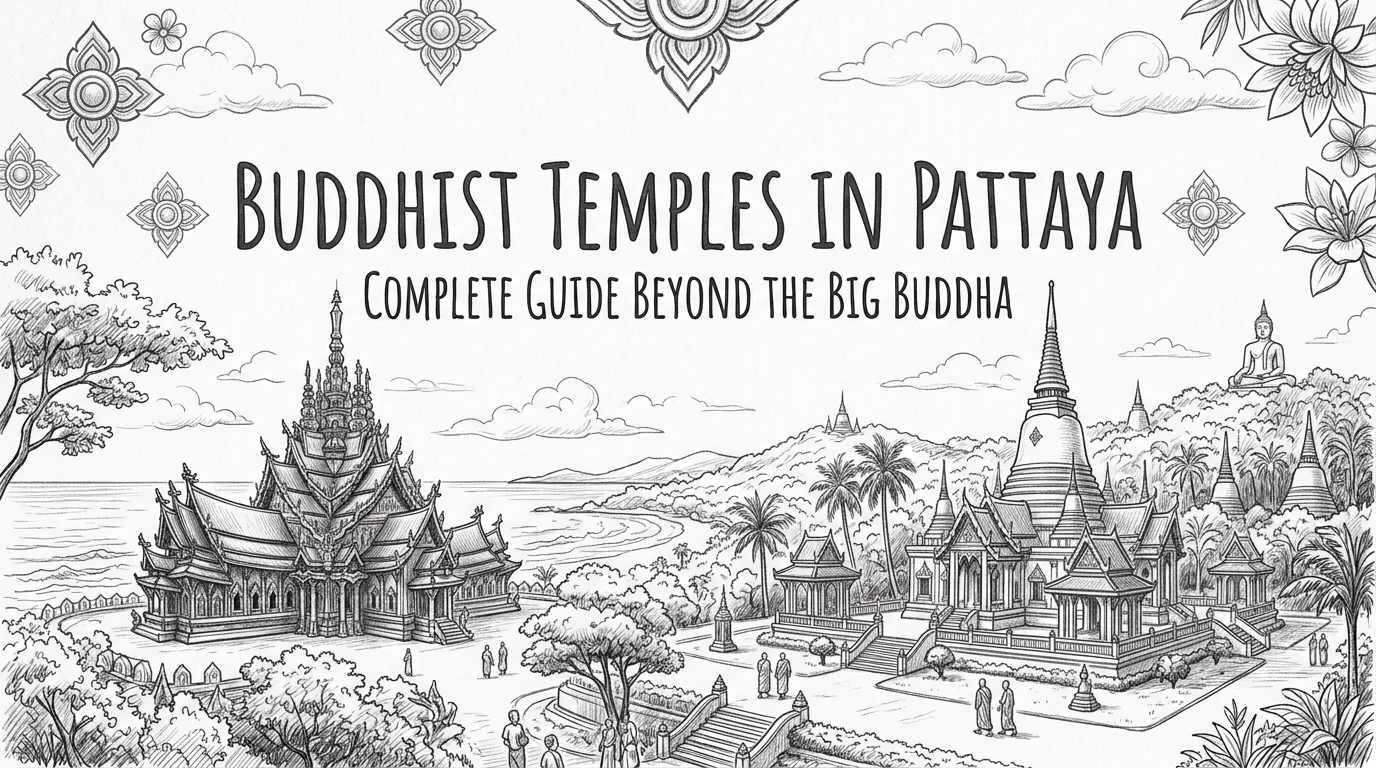
Most visitors to Pattaya know exactly one temple — the giant golden Buddha on the hill that watches over the city from Pratamnak. It is impressive, visible from the sea, and entirely worth the trip. It is also only one of several Buddhist wats in the area, each with its own history, character and reason to visit.
What makes the temples of Pattaya worth seeking out is not any single building but the contrast between them — a resort city's rhythm beside a much older, quieter Thailand.
Pattaya developed as a resort city remarkably fast, and the temples around it tell two different stories at once. Some predate the tourism industry by decades or centuries — quiet community wats that have watched the coastline transform around them. Others sit directly in the heart of the resort, absorbed into the city's daily rhythm. Together they offer a more complete picture of this stretch of coast than the beach alone ever could.
Wat Phra Yai — The Big Buddha
The temple everyone has seen, whether they realise it or not. The 18-metre seated Buddha on Pratamnak Hill is finished in gold mosaic and visible from much of central Pattaya, as well as from boats approaching the coast. Established in 1940, decades before Pattaya's resort development began, the temple predates the city in its current form by a wide margin.
The approach passes through a market of religious items and amulets — standard for Thai temple sites — before reaching the quieter hilltop gardens with views across Pattaya Bay. The image itself is best seen either early morning or late afternoon, when the light catches the gold mosaic at an angle that flattens out at midday.
Full documentation: Wat Phra Yai
Wat Khao Takiab — Monkey Temple
A short distance south on Chopstick Hill, overlooking Jomtien Beach, Wat Khao Takiab is known as much for its resident population of long-tailed macaques as for its religious significance — though it has plenty of the latter too. The temple's standing Buddha image is visible from Jomtien Beach and serves as a landmark for the southern coastline.
A practical note before visiting: the monkeys are bold and well-practised at taking food, drinks and anything loose from an open bag. This is not a minor inconvenience — it is the defining feature of a visit here, and most people who have been will tell you the same story about losing a snack within minutes of arrival.
Full documentation: Wat Khao Takiab
Wat Chai Mongkol — The Working Temple
Sitting just off Sukhumvit Road in South Pattaya, Wat Chai Mongkol is one of the few temples in the city that genuinely functions as a bridge between the Thai community and curious foreign visitors. The temple has hosted meditation sessions for the international community and maintains a school on its grounds — children's voices and classroom activity give the complex a lived-in atmosphere quite different from the more contemplative temples elsewhere.
Established in 1967, the temple's history is tied directly to Pattaya's transformation from fishing village to resort city during the post-Vietnam War period. It was built to give the growing Thai community a stable religious anchor during a period of rapid change.
Full documentation: Wat Chai Mongkol
Wat Khao Phra Bat — The Sacred Footprint
North of central Pattaya in the Bang Lamung district, Wat Khao Phra Bat sits on a forested hill, considerably quieter and less visited than the temples closer to the resort strip. The temple takes its name from a sacred Buddha footprint enshrined at the summit — one of several such pilgrimage sites scattered across Chonburi province.
The climb through forest slopes leads to genuine quiet, a working monastic community, and views across the Bang Lamung plain toward the coast. This is the temple for anyone who wants to see what Pattaya religious life looks like away from the tourist infrastructure entirely.
Full documentation: Wat Khao Phra Bat
Wat Nong Yai — The Old Bang Lamung
One of the oldest temples in the district, established in 1878, long before anyone imagined a resort city would grow up around it. Wat Nong Yai serves the older Thai residential communities of Bang Lamung and maintains a small local history museum documenting the area before tourism arrived — photographs, documents and objects that most visitors to the region never encounter.
The congregation here is almost entirely Thai, the pace unhurried, and the temple calendar follows the agricultural and religious year rather than the tourist season. It is the clearest window available into what this stretch of coast was before it became Pattaya.
Full documentation: Wat Nong Yai
Two Cities in One Place
What makes the temples of Pattaya worth seeking out is not any single building but the contrast between them. Wat Phra Yai and Wat Khao Takiab sit comfortably within the resort city's rhythm, absorbing visitors by the thousand without losing their function. Wat Khao Phra Bat and Wat Nong Yai exist almost entirely outside it, serving communities that have nothing to do with the beach a few kilometres away.
Visiting both kinds in the same trip gives a more honest sense of this coastline than staying within the resort zone ever could. Pattaya is not only what it appears to be from the beach — it is also Bang Lamung, the older district behind it, with its own temples, its own calendar, and its own much longer history.
Thai Temple Archive is documenting the temples of Chon Buri province in full, alongside Bangkok and every other region of Thailand. Browse the complete archive at thaitemplearchive.org/temples