Royal Temples of Bangkok — A Complete Guide
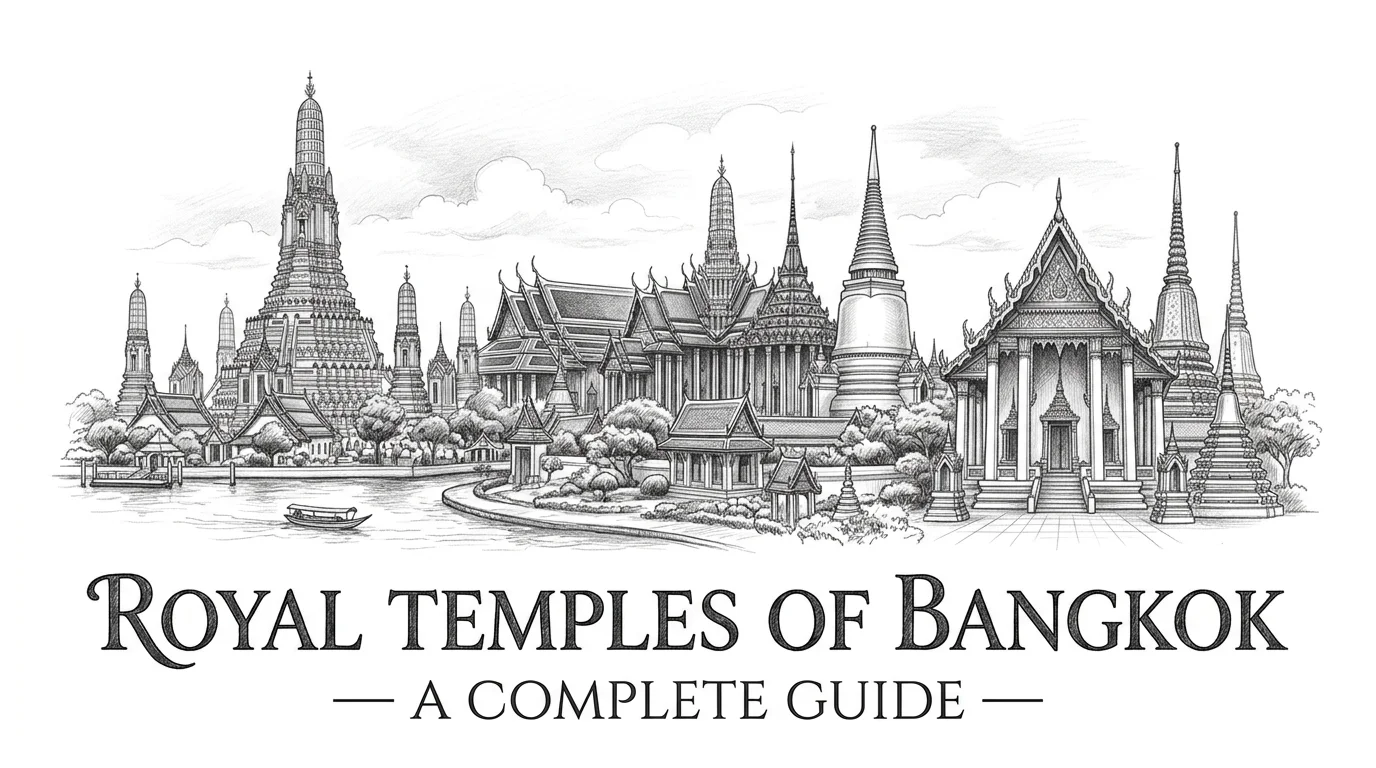
Bangkok is home to some of the most extraordinary Buddhist temples in the world. Not all temples are equal in Thailand — a select group carry the designation of royal temple, granted by the king and maintained to the highest standards of religious and architectural significance. These are the wats that defined Bangkok's sacred landscape and continue to anchor its spiritual life today.
This guide covers every royal temple in Bangkok currently documented in the Thai Temple Archive — with history, architectural notes and practical visitor information for each.
Bangkok's royal temples are not a single tradition — they are a conversation across centuries, each king adding his own voice to a sacred landscape
What Is a Royal Temple?
Thailand's Buddhist temples are classified into three royal grades — Rachavoramahavihan, Rachavoravihan and Rachavihan — plus non-royal provincial temples. Royal temples are those granted special status by the reigning monarch, typically because of their historical significance, their role in royal ceremonies, or their architectural and artistic importance.
Bangkok's royal temples were largely established during the early Rattanakosin period, between 1782 and the late 19th century, when the Chakri kings built the new capital and filled it with religious monuments that expressed both Buddhist devotion and royal power. Each temple reflects the aesthetic preferences and religious commitments of the king who built it.
Wat Phra Kaew — Temple of the Emerald Buddha
The most sacred temple in Thailand and the spiritual heart of the Grand Palace complex. Wat Phra Kaew houses the Emerald Buddha — a seated image carved from a single piece of green jasper, 66 centimetres tall, whose robes are changed three times a year by the king himself. The temple was the first structure built when King Rama I established Bangkok as the capital in 1782.
No monks reside at Wat Phra Kaew — it exists solely as a royal chapel. The surrounding complex contains some of the finest examples of Rattanakosin decorative art in existence: gilded chedis, mythological guardian figures, and kilometre-long murals depicting the Ramakien epic.
Full documentation and visitor information: Wat Phra Kaew
Wat Pho — Temple of the Reclining Buddha
Bangkok's oldest and largest temple, Wat Pho predates the city itself. The temple covers 80,000 square metres and contains over 1,000 Buddha images. Its most famous resident is the Reclining Buddha — 46 metres long, 15 metres high, covered in gold leaf, its feet inlaid with 108 mother-of-pearl symbols.
Wat Pho is also the birthplace of traditional Thai massage. Stone inscriptions of massage techniques commissioned by King Rama III line the temple walls — the world's first public health curriculum, inscribed in stone in the 1830s.
Full documentation and visitor information: Wat Pho
Wat Arun — Temple of Dawn
The most recognisable silhouette on the Bangkok skyline — a 79-metre prang on the Thonburi bank of the Chao Phraya, covered entirely in fragments of Chinese porcelain arranged into intricate floral patterns. At dawn and dusk the surface catches the light in a way no photograph fully captures.
Wat Arun briefly housed the Emerald Buddha during the Thonburi period before King Rama I moved it across the river. The temple's current form was completed under King Rama III, who commissioned the porcelain decoration and elevated the central prang to its current height.
Full documentation and visitor information: Wat Arun
Wat Suthat — Temple of the Giant Swing
One of Bangkok's six first-class royal temples, Wat Suthat took 27 years to complete across three reigns. The main ubosot houses Phra Sri Sakyamuni — a 13th-century Sukhothai Buddha transported from the north by river, a journey that reportedly took three years.
Outside the gates stands Sao Ching Cha — the Giant Swing — a towering red teak frame used in Brahmin ceremonies where young men swung at great height to catch bags of gold coins. The ceremony was discontinued in 1935 after fatal accidents. King Rama II personally carved the main doors of the ubosot — panels of extraordinary woodwork depicting Hindu mythology.
Full documentation and visitor information: Wat Suthat
Wat Benchamabophit — The Marble Temple
Built by King Rama V in 1899 from Carrara marble imported from Italy, Wat Benchamabophit is one of the last great royal temples constructed in Bangkok and one of the most photographed. The rear courtyard contains 52 bronze Buddha images assembled by King Rama V as a survey of Buddhist artistic traditions across Asia.
At dawn, monks collect alms outside the gates in a scene that has become one of Bangkok's most iconic images. The cool white marble surfaces catch the morning light differently at each hour — the temple is worth visiting at multiple times of day.
Full documentation and visitor information: Wat Benchamabophit
Wat Saket — The Golden Mount
An artificial hill rising 80 metres above the flat Bangkok plain, crowned by a golden chedi enshrining a Buddha relic brought from India by Lord Curzon in 1897. The hill was an accident — King Rama III began a massive chedi that collapsed under its own weight, leaving rubble that was later built upon by King Rama IV.
The 318-step climb through frangipani gardens is one of Bangkok's most rewarding ascents. During the cholera epidemic of 1820, tens of thousands of bodies were brought here for sky burial — a history that gives the Golden Mount a layer of meaning its tourist brochures rarely mention.
Full documentation and visitor information: Wat Saket
Wat Ratchanatdaram — The Loha Prasat
Home to the Loha Prasat — Metal Castle — one of only three such structures ever built in the world. Thirty-seven iron spires represent the 37 virtues required to attain enlightenment. The design references a structure built in Sri Lanka around 300 BCE, described in Pali Buddhist texts and reconstructed here by King Rama III in 1846.
The surrounding grounds contain one of Bangkok's most active amulet markets, where collectors and monks browse alongside tourists in a tradition of religious commerce that has operated here for generations.
Full documentation and visitor information: Wat Ratchanatdaram
Wat Mahathat — Centre of Buddhist Scholarship
Thailand's national centre of Theravada Buddhist study, home to Mahachulalongkornrajavidyalaya University and the headquarters of the Mahanikaya monastic order. Monks from across Southeast Asia study here. The temple also houses Bangkok's principal centre for vipassana meditation instruction, open to foreign visitors.
Section Five of the grounds contains a traditional medicine market and amulet traders — a working ecosystem of folk healing and spiritual commerce that has operated in the shadow of Thailand's most scholarly temple for generations.
Full documentation and visitor information: Wat Mahathat
Wat Bowonniwet — Where Kings Are Ordained
Every Thai king since Rama IV has been ordained as a monk at Wat Bowonniwet. The temple is the headquarters of the Dhammayut Order — the reform movement founded by King Rama IV before his accession — and maintains the strictest standards of monastic discipline in Bangkok.
The temple's murals by monk-artist Khrua In Khong are among the most remarkable in Thailand: Western ships, European soldiers and foreign buildings rendered alongside traditional Buddhist imagery, painted by a man who had never left Thailand but absorbed Western perspective techniques through engravings and diplomatic gifts.
Full documentation and visitor information: Wat Bowonniwet
Wat Ratchabophit — Bangkok's Most Unexpected Temple
King Rama V's most personal architectural experiment — a circular cloister of gilded columns surrounding a European Gothic spire, its interior walls lined with French porcelain tiles in five colours representing the ranks of Thai nobility. The ordination hall interior is panelled in pale Gothic style with Venetian mosaic floors and stained glass windows — and a gilded Thai Buddha at the altar.
Wat Ratchabophit is the least visited major royal temple in Bangkok and arguably the most surprising. Nothing prepares you for the interior.
Full documentation and visitor information: Wat Ratchabophit
Wat Ratchapradit — The Quiet Royal Temple
King Rama IV's personal royal temple, built in 1864 for the Dhammayut Order he founded. Small, precise and almost entirely overlooked by visitors who pass it on the way to the Grand Palace. The mother-of-pearl inlay doors are considered among the finest 19th century craftsmanship in Bangkok.
Wat Ratchapradit receives almost no tourist visitors — which makes it one of the most peaceful places in the historic centre of Bangkok.
Full documentation and visitor information: Wat Ratchapradit
Exploring Bangkok's Royal Temples
Bangkok's royal temples are not a single tradition but a conversation across centuries — each king adding his own voice, his own aesthetic, his own religious priorities to a sacred landscape that began with Rama I in 1782 and continued through the reign of Rama V at the turn of the 20th century.
Some are unmissable landmarks visited by millions. Others are overlooked entirely, standing quietly beside the more famous monuments without a single tourist in sight. All of them repay careful attention.
Thai Temple Archive is documenting every one of them — and every temple beyond them, across all 77 provinces of Thailand. Browse the complete Bangkok temple archive.