Thai Temple Architecture: A Complete Guide to Styles, Periods and Sacred Structures
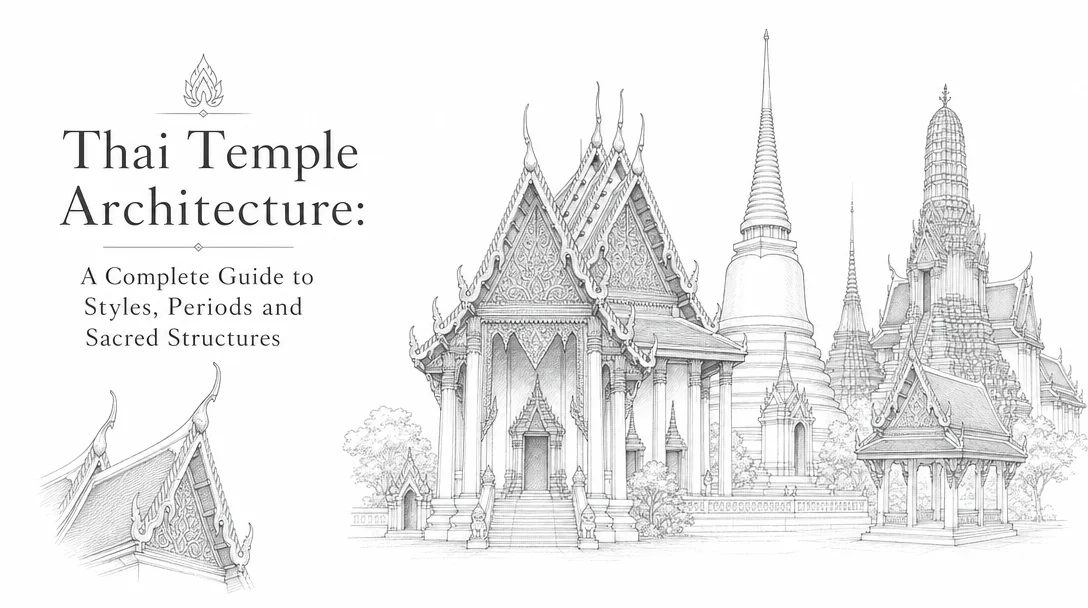
Walk through enough Buddhist temples in Thailand and a pattern begins to emerge — not of sameness, but of family resemblance. The swooping rooflines, the gilded spires, the naga serpents coiling along staircase balustrades, the cool dimness of ordination halls decorated with murals that seem to absorb centuries of incense smoke. These things recur. And yet every region, every historical period, every royal dynasty left its own unmistakable imprint.
Understanding Thai temple architecture is not a matter of memorizing facts. It is a way of reading a building — understanding what its proportions mean, why its roof curves the way it does, what the guardian figure at the gate is protecting, and what century and what kingdom its builders came from.
This guide covers the major architectural styles of Thai Buddhist temples, the key structural elements found across all of them, and the vocabulary you need to navigate the archive with confidence.
The Wat — What a Thai Temple Complex Actually Is
Before styles and periods, a foundation: in Thailand, a Buddhist temple is called a wat. The word refers not to a single building but to an entire compound — a walled precinct containing multiple structures, courtyards, living quarters for monks, and a range of sacred buildings each with a distinct function.
A typical wat is divided into two main zones. The Phutthawat is the sacred area dedicated to religious practice — the ordination hall, the assembly hall, the chedis. The Sangkhawat is the residential area where monks live, study, and eat. Both zones are usually enclosed within the same outer wall, often punctuated by decorative gates.
This compound structure is consistent across all regions and periods. What changes — dramatically — is what the buildings within it look like.
The Five Major Architectural Periods
1. Dvaravati (6th–11th century)
The earliest Buddhist architectural tradition in what is now Thailand was shaped by the Mon people of the Dvaravati kingdom, centered in the central plains. Their temples were modest by later standards — simple brick structures, often circular or octagonal chedis with tiered bases influenced by Indian forms. The Wheel of the Law (dharmachakra) was a central motif, appearing as stone carvings at many Dvaravati sites.
Surviving examples are fragmentary, but the influence of Dvaravati on later Thai traditions is profound. It established Theravada Buddhism as the dominant tradition and introduced the basic vocabulary of sacred structures that all subsequent periods would build upon.
2. Khmer Influence and the Lopburi Style (11th–13th century)
From the 11th century onward, the Khmer Empire of Angkor extended its influence deep into the central plains and northeast of modern Thailand. The architectural impact was transformative: the Khmer prang — a tall, corn-cob-shaped tower of corbelled stone — entered the Thai vocabulary and never left.
The Lopburi style temples of this period are characterized by their laterite and sandstone construction, their prangs decorated with carved Hindu and Buddhist iconography, and a monumentality quite different from anything that came before. Phimai Historical Park in Nakhon Ratchasima province remains the most complete example — a Khmer-period sanctuary of extraordinary scale and refinement, predating Angkor Wat in some of its elements.
The northeast of Thailand (Isan) preserves more Khmer-period temples than any other region. Many are off the standard tourist circuit and survive in various states of preservation — among the most compelling destinations for serious students of the tradition.
3. Sukhothai (13th–15th century)
The Sukhothai kingdom, established in the 13th century in what is now northern-central Thailand, produced a style of temple architecture of remarkable elegance and originality. Sukhothai architects synthesized Khmer forms with Sri Lankan influences — particularly the bell-shaped chedi brought from Ceylon — and softened both into something distinctly their own.
The defining feature of Sukhothai temple architecture is the lotus-bud finial at the top of its chedis: a tapered, flame-like form that rises from a bell-shaped base with a lightness quite unlike the solid mass of Khmer towers. Walking kingfisher-colored chedis reflected in the water of Sukhothai Historical Park at dawn is one of the genuinely transcendent experiences of Thai heritage travel.
Sukhothai also produced the Walking Buddha — a sculptural innovation of astonishing fluidity that became one of the defining forms of Thai Buddhist art. The temples that house them carry that same quality: graceful, balanced, deeply considered.
4. Ayutthaya (14th–18th century)
The Ayutthaya kingdom lasted over four centuries and absorbed, synthesized, and transformed every architectural tradition that preceded it. Ayutthaya-period temples are the most numerous surviving pre-modern temples in Thailand, and their range is extraordinary — from the ruined grandeur of the old capital (a UNESCO World Heritage Site) to thousands of provincial wats still in active use across the central plains.
Ayutthaya architecture is distinguished by its prang — the Khmer tower form reinterpreted and elongated into something taller, more vertical, more dynamic. Ayutthaya prangs are typically built of brick covered with stucco, decorated with stucco carvings that weather over centuries into the haunting, eroded textures visible throughout the old capital. The tiered rooflines characteristic of later Thai temples become more complex during the Ayutthaya period, and the multicolored glazed ceramic tiles that decorate gables and eaves begin to appear.
The destruction of Ayutthaya by the Burmese in 1767 was catastrophic. The ruins of the old capital preserve the scale and ambition of what was lost — row upon row of decapitated Buddha images, headless torsos of immense prang complexes, trees growing through collapsed walls. It is one of the most haunting archaeological landscapes in Southeast Asia.
5. Rattanakosin (18th century–present)
When King Rama I established Bangkok as the new capital in 1782, he set out to recreate the grandeur of Ayutthaya — and in many respects surpassed it. The Rattanakosin style that emerged under the Chakri dynasty synthesized Ayutthaya forms with Chinese decorative influences, European structural elements introduced during the colonial era, and a new opulence of surface decoration that reflects the wealth and ambition of a kingdom that had survived the fall of its predecessor.
Rattanakosin architecture is characterized by intricate multi-tiered roofs, golden spires, and detailed decorative elements. The gilded mosaic work covering structures like Wat Phra Kaew and Wat Pho is not merely decorative — it is a theological statement about the presence of the sacred, the luminosity of awakening made material in colored glass and gold.
Khmer, Chinese, northern Thai, and Western elements were fused to create temples and palaces in the Rattanakosin style, of which the key features are height and lightness. Over the 19th century, as Thailand navigated the pressures of European colonialism, Western architectural elements — arched windows, Italian marble floors, neoclassical facades — appeared alongside traditional Thai forms in increasingly confident hybrids.
The Lanna Tradition — Northern Thailand's Distinct Language
The Lanna kingdom of northern Thailand — centered on Chiang Mai, founded in 1296 — developed an architectural tradition so distinct from the central Thai mainstream that it deserves separate treatment.
The Lanna style of temple architecture is characterized by its distinctive stepped roofs, intricate wood carvings, and vibrant use of colors, showcasing a harmonious blend of Thai and Burmese architectural influences, reflecting the historical relationship between the two regions.
Lanna temples are often lower to the ground than their Rattanakosin counterparts, broader, with rooflines that sweep almost to the ground in some of the most dramatic examples. The use of teak wood — for structural elements, for carved decorative panels, for entire viharns — gives Lanna temples a warmth and intimacy quite different from the stone and stucco formality of Bangkok. Lacquerwork, gilded woodcarving, and the distinctive Lanna Buddha image style (oval face, arched eyebrows, flame-shaped ushnisha) are hallmarks of the tradition.
The Burmese occupation of Lanna from 1558 to 1774 left a deep architectural imprint. Many temples in Chiang Mai, Lampang, and Chiang Rai show Burmese structural details — multi-tiered wooden spires, Burmese-style chedis, and the distinctive ho trai (scripture library) raised on stilts over a pond to protect manuscripts from insects.
The Essential Vocabulary — Parts of a Thai Temple
Regardless of regional style or historical period, Thai Buddhist temple complexes share a common architectural vocabulary. Understanding these terms transforms a temple visit from a walk through beautiful but opaque spaces into a legible landscape.
Ubosot (Bot) — The ordination hall is the most sacred building in a temple compound, used exclusively for Buddhist ceremonies including the ordination of monks. It is typically surrounded by eight sema stones (boundary markers) buried in the ground or set on pedestals at the cardinal and intermediate points of the compass. These stones define the consecrated ground within which ordinations are valid. Architecturally, the ubosot is usually the most elaborately decorated building in the compound.
Viharn (Wihan) — The assembly hall is where monks gather for daily chanting and where worshippers come to pray. Unlike the ubosot, the viharn has no sema stones and is not restricted for ceremonial use. Many temple compounds contain multiple viharns, sometimes built in different periods reflecting the expansion of the community over centuries.
Chedi (Stupa) — The chedi is the most ancient structural form in the Buddhist architectural tradition, derived ultimately from the burial mound. In Thailand, chedis contain relics — of the historical Buddha, of revered teachers, or of royalty. Their forms vary considerably by period and region: bell-shaped Sukhothai chedis, elongated Ayutthaya prangs, tiered Lanna chedis, and the massive gilded mounds of Bangkok's royal temples all serve the same fundamental purpose. Worshippers circumambulate chedis clockwise as an act of reverence.
Prang — The tall, tower-like structure derived from the Khmer tradition, the prang is the dominant vertical element in Ayutthaya and Rattanakosin architecture. Where chedis tend toward rounded, bell-like forms, prangs are angular, corbelled, and dramatically vertical. The prang was adapted from the Khmer and became more slender and vertical in Thai interpretation.
Ho Trai — The scripture library, housing the Buddhist canon (Tipitaka) and other sacred texts. In central Thai temples, the ho trai is often a small, elaborately decorated building raised on a platform; in Lanna tradition, it is frequently built on stilts over water to protect manuscripts from insects and flooding.
Mondop — A square, multi-tiered structure typically used to enshrine a particularly sacred object — a Buddha footprint, a relic, or a revered image. The mondop form is most prominent in central Thai architecture and often displays some of the finest decorative craftsmanship in a temple compound.
Sala — Open-sided pavilions used for a variety of purposes: rest, teaching, the distribution of food to monks, community gatherings. Salas are the most utilitarian structures in a temple compound and often the most recently built.
Naga — The mythological serpent whose image appears throughout Thai temple architecture — coiling along staircase balustrades, rising from gable ends, framing doorways. In Buddhist cosmology, the naga is associated with water, protection, and the story of the naga king who sheltered the meditating Buddha from rain. A temple approached via a staircase flanked by naga balustrades is a common sight across all regions.
Chofa — The distinctive finial at the tips of Thai temple rooflines, curving upward like the beak of a mythological bird (Garuda or Hong). The chofa is one of the most recognizable elements of Thai temple silhouettes and appears across all regional styles, though its precise form varies.
How to Read a Temple You've Never Seen Before
With this vocabulary established, it becomes possible to approach any Thai temple and extract meaningful information before reading a single sign or guidebook entry.
Look at the chedi first. Its form will tell you the dominant tradition: bell-shaped with a lotus-bud finial suggests Sukhothai influence; a tall, angular prang suggests Ayutthaya or Khmer roots; a tiered, multi-level structure points toward Lanna. In many temples you will find chedis of different periods within the same compound — evidence of centuries of construction, expansion, and renovation layered into a single space.
Read the rooflines. The number of tiers, the angle of the slope, the presence or absence of carved bargeboards, the material — glazed ceramic tile, terracotta, wooden shingle — all encode regional and temporal information. Lanna rooflines sweep low and wide; Rattanakosin rooflines rise steeply with elaborately carved gables.
Notice what the decorative program tells you. Murals inside viharns and ubosots typically depict scenes from the Jataka tales (the previous lives of the Buddha) or the Traiphum cosmology (the three worlds of Buddhist cosmology). Their style — the degree of naturalism, the treatment of landscape, the presence of contemporary detail — can often be dated with reasonable precision.
Look for the sema stones. If you find eight boundary markers around a building, you are standing near an ubosot. If there are none, it is a viharn. This distinction matters: the ubosot is the most sacred space in the compound.
Check for Chinese influence. In temples built or extensively renovated during the 19th and early 20th centuries, Chinese architectural and decorative elements are common — ceramic roof decorations, painted porcelain tiles, guardian figures in Chinese court dress. This reflects both trade relationships and the significant Chinese-Thai community that funded much of Bangkok's temple construction.
Why Regional Variation Matters
The architectural diversity of Thai Buddhist temples is not merely an aesthetic phenomenon — it is a record of history. The temples of Isan carry the memory of Khmer sovereignty. The teak viharns of Lampang document a tradition of woodcraft that has largely disappeared elsewhere. The ruined stupas of Sukhothai Historical Park preserve a vision of sacred space — luminous, water-reflected, ringed by forest — that shaped the Thai artistic imagination for five centuries.
When Thai Temple Archive photographs a rural wat in a province that few visitors reach, we are documenting a node in this larger network — a building that expresses, in its proportions and its details and its state of repair, something about the community that built it, the kingdom it belonged to, and the faith that has animated it for generations.
The archive is not a collection of beautiful buildings. It is a record of a civilization's way of understanding the world.
A Living Tradition
One final point, worth emphasis: Thai Buddhist temples are not monuments. They are not museums or ruins or heritage sites in the European sense, cordoned off from daily life and managed for visitor experience. They are living institutions — communities of practice, centers of education, providers of social services, spaces of daily worship and annual festival.
The architectural forms described in this guide are not frozen in any period. They continue to evolve. New temples are built every year in Thailand, some in strict historical styles, others in contemporary idioms that would be unrecognizable to a Sukhothai master builder. Old temples are renovated, expanded, and sometimes transformed almost beyond historical recognition by the devotion and resources of their congregations.
Understanding the history of Thai temple architecture is not a way of preferring the old to the new. It is a way of grasping the depth of a tradition that has been continuously reinvented across twelve centuries — and continues to reinvent itself today.
Thai Temple Archive is documenting this tradition one temple at a time — from the most celebrated royal wats to the most remote village shrines. Explore the archive at thaitemplearchive.org.